
Things to do in Koronisia
Koronisia is small and the list of "sights" is short: you walk the village and its harbour, swim in the shallow water of the Amvrakikos, climb to the Byzantine monastery, watch birds in the wetland, and eat fish at a table over the water. Two days covers the village; more is worth it if you use it as a base for Epirus.
If you are looking for organised tourist infrastructure — sunbeds, water sports, nightlife — Koronisia is not it. This is a fishing village inside a protected wetland, and everything you do here has to do with the water, the birds, the food and the light.
That does not mean there is nothing to do. It means nothing is packaged for you. Below is what visitors actually do, how long each thing takes, and what sits within a day trip.
How many days you need
You can see the village itself in an afternoon. To actually experience it — a morning swim, birds at first light, the sunset, dinner at a taverna — you want two days.
If you also plan to explore Epirus, three to five days is the right length: Koronisia becomes the quiet base you come back to in the evening rather than another place you pass through.
- One night
- the village, the monastery, one dinner and the sunset
- Two days
- adds swimming, an early birdwatching walk and time to slow down
- Three to five days
- with day trips to Arta, Preveza and the Ionian beaches
The village on foot
The whole of Koronisia is walkable. There is no waymarked route and none is needed: start at the square, drop down to the little harbour with the fishing boats, and follow the shoreline for as long as you feel like.
It is the most underrated thing to do here, and it is best early in the morning or late in the afternoon, when the fishermen are working on their nets and the light sits low over the lagoon.
- The harbour and the moored caiques — the village’s actual working day, not a set piece.
- The lagoon road with water on both sides, more striking on foot than from the car.
- The high point of the settlement, where the Byzantine monastery stands.
- The tavernas with tables built out over the water, even outside meal times.
In and on the water
The Amvrakikos is an enclosed gulf: the water around Koronisia is shallow, calm and warm, with no waves. That makes it ideal for children and for anyone who would rather not deal with surf — but it is not an organised beach with sunbeds, it is a quiet shoreline next to the village.
Because there is no swell, the flat water suits a kayak or a paddleboard. There is no permanent rental in the village, so bring your own if this matters to you.
For long sandy open-sea beaches, the nearest option is the Ionian coast towards Preveza and Loutsa, about an hour by car. Plenty of guests do both.
Birds and the wetland
Koronisia sits inside the Amvrakikos Wetlands National Park, one of the most important wetland systems in the Mediterranean. Flamingos, herons and pelicans are the species even a non-birder will recognise.
You need neither a guide nor equipment for a first encounter: just be outside early in the morning or at dusk, when the birds feed in the shallows. A pair of binoculars changes the experience completely.
The evening: sunset and dinner
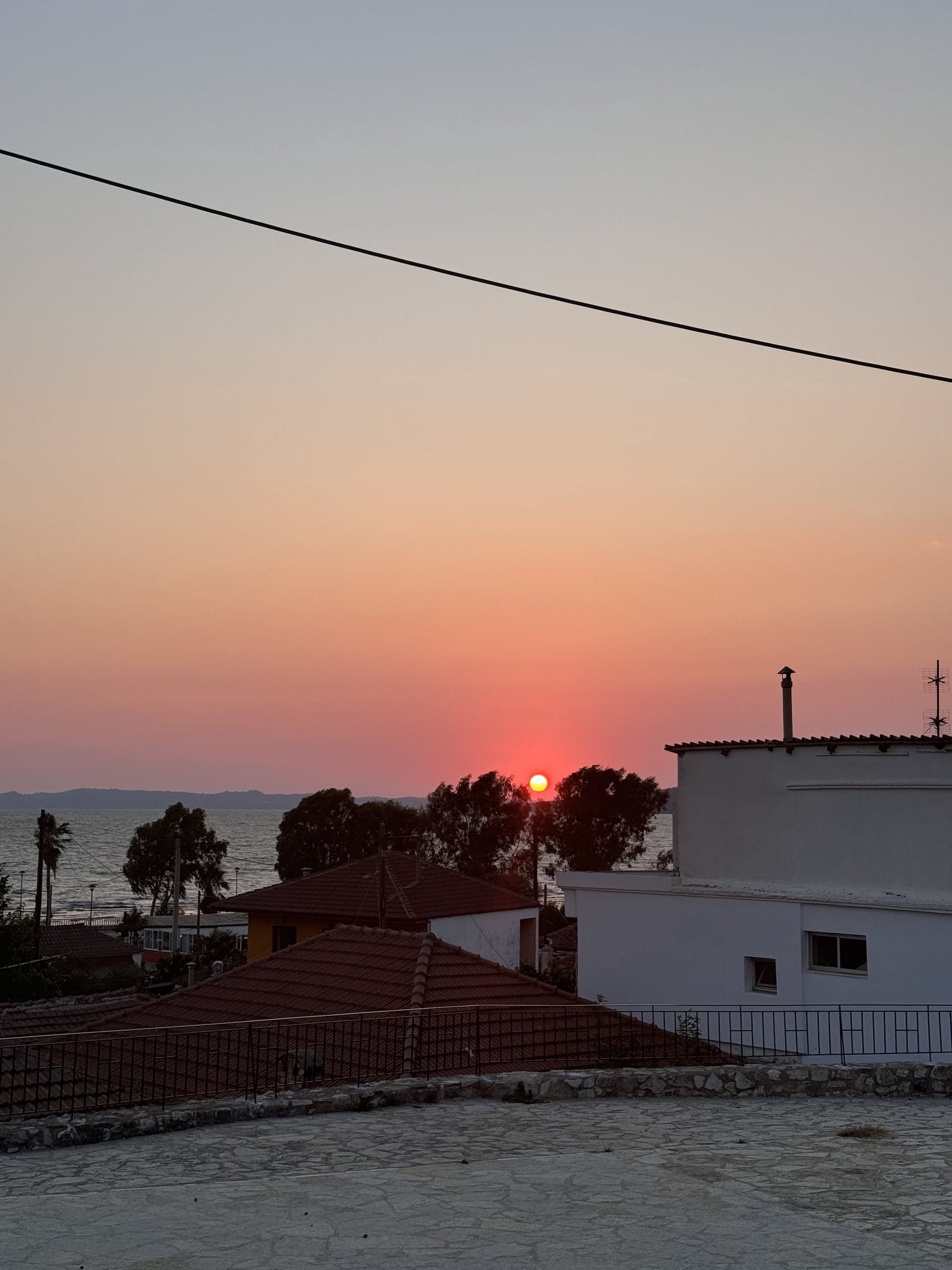
This is the real itinerary of Koronisia and the reason most people remember the place. Walk up to the monastery late in the afternoon, stay while the light drops across the gulf, then come down for dinner.
At the table, ask for Amvrakikos shrimp — the best known product of the area. You will also find grey mullet, sea bream, eel and bottarga, alongside the pies Epirus is known for.
Day trips
You need a car — there is no regular public transport from the village. With one, though, Koronisia is a good base: most of southern Epirus is within two hours.
- Arta
- the historic bridge and the Byzantine monuments · about 35 minutes
- Preveza
- town, food and an evening walk · about 1 hour
- Nicopolis
- the Roman archaeological site · about 1 hour
- Lake Zirou
- nature and walking · about 1 hour
- Ionian beaches (Monolithi, Loutsa)
- open sea and sand · about 1 hour 30 minutes
- Acheron Springs
- river and walking trails · about 1 hour 45 minutes
- Lefkada
- island beaches, reached by bridge · about 1 hour 30 minutes
If the weather turns
The wetland is just as interesting under cloud — often more so, because the light is kinder for photography and the birds are not hiding from the heat.
Otherwise Arta, 35 minutes away, gives you a full day indoors: monuments, cafés and the market. And dinner at a taverna does not depend on the weather.
Frequently asked questions
Is there enough to do in Koronisia?
For two days, yes: walking the village and harbour, swimming in the shallow water, the Byzantine monastery, birdwatching and dinner at a seafood taverna. For longer you will want a car and day trips into the rest of Epirus. This is a quiet village, not a resort.
Is Koronisia good for children?
Yes, mainly because of the water: the Amvrakikos is an enclosed gulf, so the sea is shallow, calm and warm with no waves. The village is small and quiet. There are, however, no organised children’s activities.
Can you swim at Koronisia?
Yes. It is not an organised beach with sunbeds but a quiet shoreline beside the village, with shallow, calm water. For long open-sea sandy beaches, the Ionian coast is about an hour away.
What is there to do in the evening?
The sunset from the monastery and dinner at a taverna built over the water. There is no nightlife — for bars and an evening out, Preveza is about an hour away.
Do you need a car in Koronisia?
Not for the village itself, which is entirely walkable. But you need one to get there and for any day trip: there is no regular public transport to the village.
Are there organised activities or tours?
Koronisia has no permanent tourist infrastructure with scheduled activities or equipment rental. If a boat trip or a wetland tour matters to you, ask locally or contact us before you arrive.
Continue the guide
- Swimming and beaches— What the gulf water is like, and which Ionian beaches are worth the drive.
- Birds and the National Park— Flamingos, Dalmatian pelicans, dolphins: where and when to see them.
- Food and tavernas— Amvrakikos shrimp, the catch of the day, and when the tavernas actually open.
- The Byzantine church— The Monastery of the Nativity of the Theotokos: history, visiting, and its feast day.
- When to visit— Month by month: swimming, birds, quiet, and when the village fills up.
- Back to the Koronisia guide